
- The Estuary Examiner
- Fall 2026
- Tracking Sharks Beneath the Surface
By Matthew Bernanke, M.Sc., Stewardship Coordinator
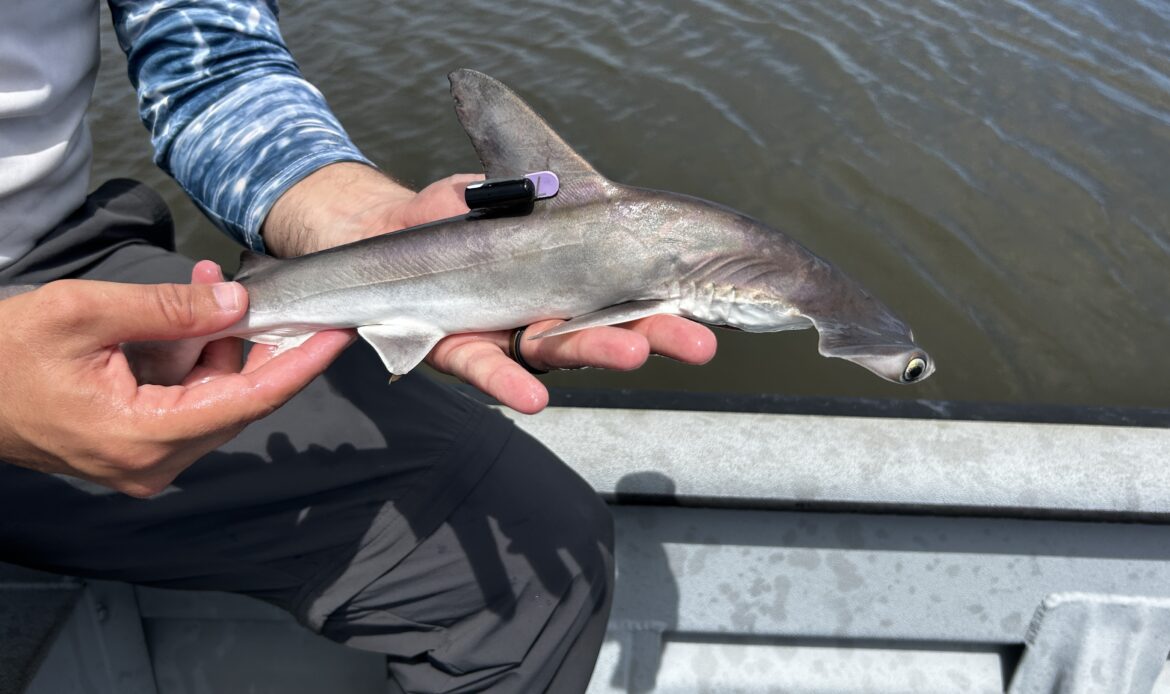
A small acoustic transmitter allows researchers to detect a tagged scalloped hammerhead when it swims within range of an acoustic receiver.
Acoustic telemetry is giving GTM researchers a new window into how sharks and fish move through the estuary—and beyond.
What happens after a shark disappears beneath the surface? At the GTM Research Reserve, researchers don’t necessarily lose track of it.
Using a technology called acoustic telemetry, GTM scientists are following the movements of sharks and fish throughout the Reserve, gathering information that can help reveal where animals travel, which habitats they use and how long they remain in particular areas.
The research is especially important for one remarkable summer visitor: the scalloped hammerhead shark (Sphyrna lewini).
Previous research has identified waters within the GTM Research Reserve as a communal nursery for several shark species, including the critically endangered scalloped hammerhead. Understanding how these young sharks use the estuary could provide valuable information for their conservation and management.
During the 2026 tagging season, GTM staff tagged 24 scalloped hammerheads, four finetooth sharks and two sandbar sharks. At the close of the season, the team planned to resume tagging in summer 2027.
Following a shark’s journey
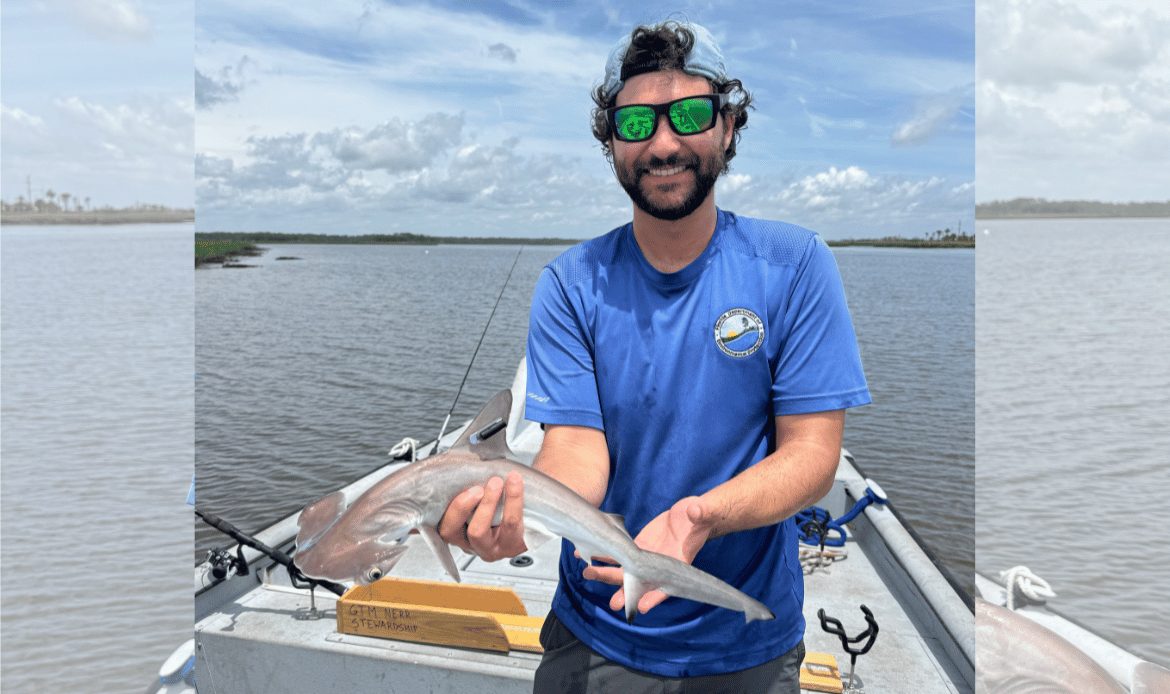
Matthew Bernanke, M.Sc., Stewardship Coordinator, holds an acoustically tagged scalloped hammerhead shark during GTM Research Reserve fieldwork.
Acoustic telemetry works a little like an underwater identification system.
Researchers equip an animal with a small electronic transmitter carrying its own unique ID. Depending on the species and study, the transmitter may be attached externally or surgically implanted.
When the animal swims within range of an underwater acoustic receiver, the receiver records the transmitter ID along with the date, time and location of the detection.
Over time, those individual detections begin to create a picture of the animal’s movements.
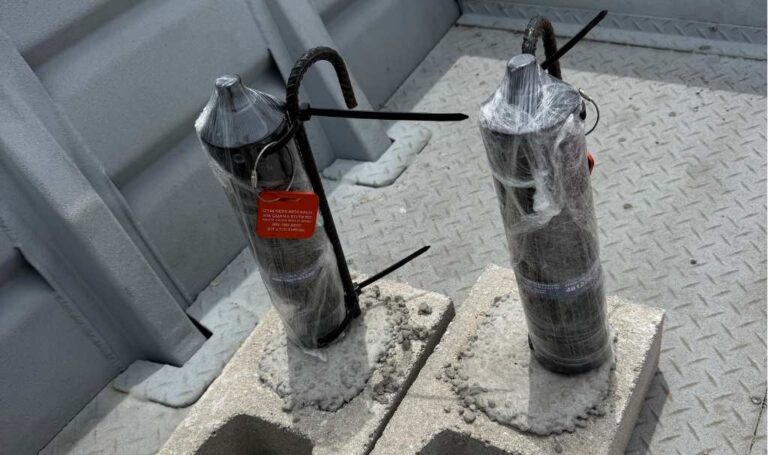
GTM Research Reserve staff have deployed 33 acoustic receivers throughout the Reserve, creating a network capable of detecting tagged animals as they move through different waterways and habitats.
Those receivers quietly listen around the clock, collecting information researchers can later download and analyze.
For scalloped hammerheads, the resulting data can help scientists better understand how young sharks use the estuary and how environmental conditions may influence their movements.
From tagging to data
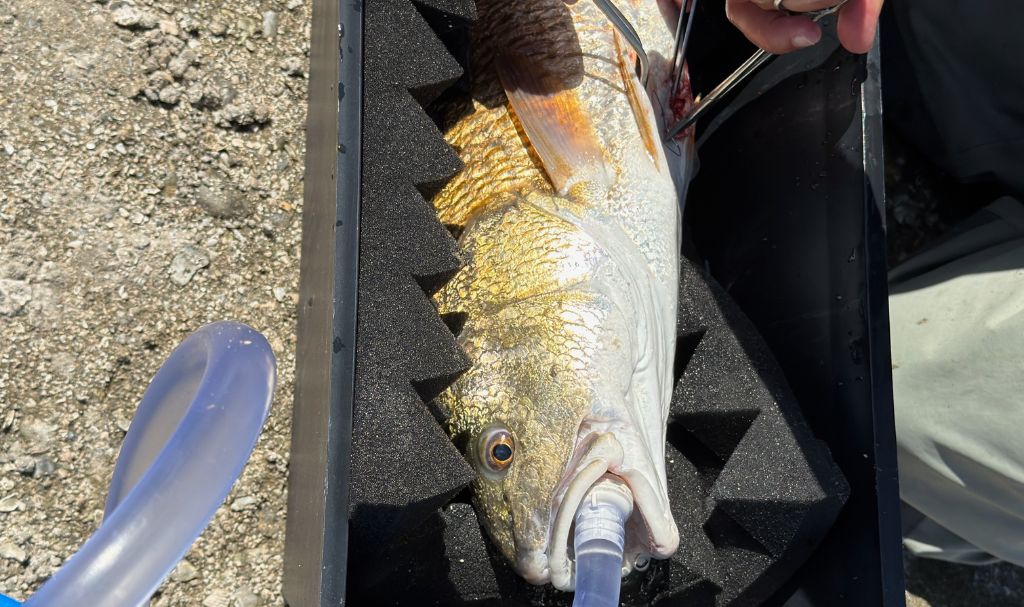
Researchers implant an acoustic transmitter in a red drum while water is continuously pumped over the fish’s gills to keep them oxygenated during the procedure.
Scalloped hammerheads aren’t the only sharks, and sharks aren’t the only animals, researchers can follow with this technology.
GTM staff and collaborating scientists are using acoustic telemetry to study a variety of ecologically, recreationally and commercially important fish and shark species.
For some species, transmitters are carefully implanted through a small surgical procedure before the animal is released. Once tagged, the fish can potentially be detected again and again without researchers needing to capture it each time.
That ability to passively collect information is one of acoustic telemetry’s greatest strengths. A receiver may document an animal weeks or months after tagging, helping researchers build a much more complete picture of its movements than a single encounter could provide.
Science without boundaries
The story can continue even when a shark leaves GTM waters.
Acoustic telemetry researchers participate in collaborative networks that allow scientists to share detections from receiver arrays in different locations. If a shark tagged at GTM travels into another waterway equipped with compatible receivers, researchers there may detect it and share that information with GTM. Likewise, GTM’s receivers may detect animals tagged by scientists elsewhere.
That turns the Reserve’s acoustic array into something larger than a single research project. It becomes part of a broader scientific network—and a resource for GTM staff, visiting investigators and researchers studying marine animals throughout the region.
What happens after a shark disappears beneath the surface? Within the Reserve, any of GTM’s 33 underwater receivers can record a tagged shark as it swims past. Farther along the coast, another research team may pick up its signal. And with every detection, researchers learn a little more about a world that is usually hidden beneath the surface.
Help protect the coast they call home.
Support the research and conservation work that helps us understand sharks and protect the coastal habitats they depend on.