By Nikki Dix, Ph.D., Research Director
Protecting our coastal environments can be complicated by the complexity of ecology. That’s why I love research.
Research gives us a way to ask questions, test ideas and better understand the ecosystems we are working to protect. Just as important, it gives us a chance to help train the scientists who will carry that work forward.
Through my faculty role at the University of North Florida, I have the opportunity to advise students by serving on graduate committees alongside professors from UNF and other universities. Right now, four students from UNF’s Biology Department are in the beginning stages of their research journeys at GTM Research Reserve.
All four are passionate about healthy coastal ecosystems and are dedicating their time and energy to applied research with conservation applications. And they have quickly become part of the GTM community.
Research takes a lot of people, and these projects are no exception. GTM staff, rangers and volunteers have all pitched in—helping collect data in the field, sharing equipment and expertise, providing training and connecting students with other scientists.
We’re having a lot of fun working with them, too. Their energy, curiosity and new ideas are refreshing and inspiring!
Madelyn Moore

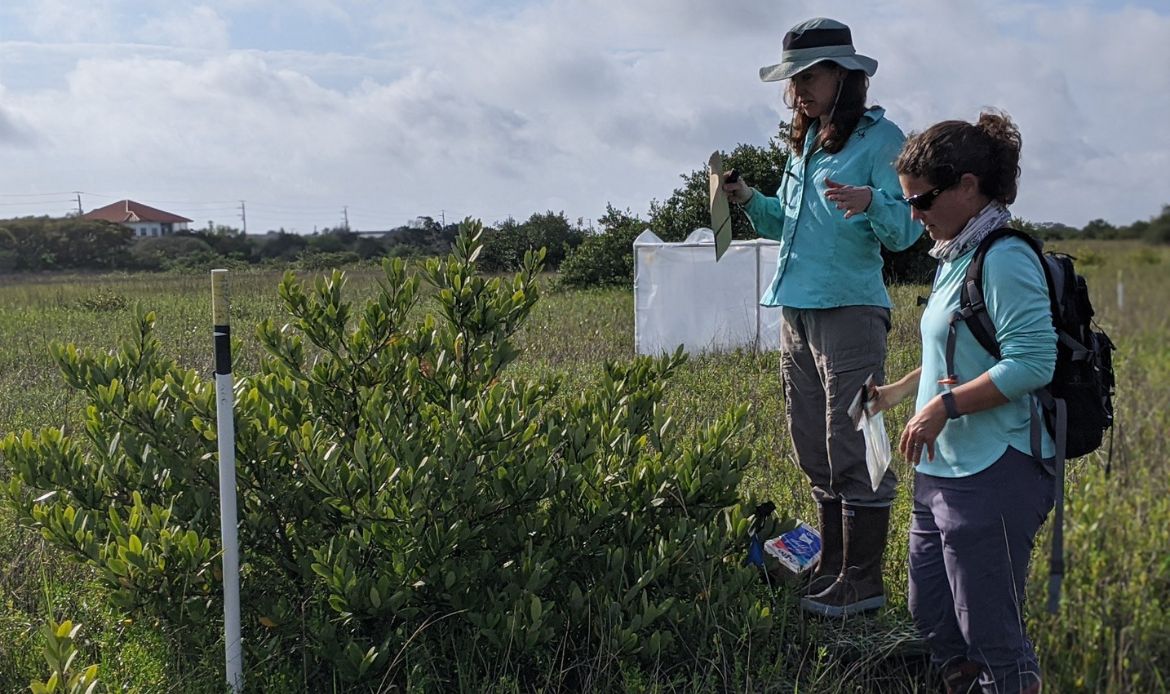
Madelyn Moore surveys mangroves following the February freeze.
Madelyn Moore jumped right into coastal wetland research. Following the February freeze, she helped researchers from GTM and Villanova University survey mangroves to understand how they responded to the cold temperatures.
Her thesis research is exploring how mangrove expansion into salt marshes is changing greenhouse gas emissions. Mangroves and salt marsh grasses are both good at sequestering and storing carbon from the atmosphere, important for mitigating climate change, but they also emit methane.
Madelyn is using small, portable greenhouses to measure gas fluxes, compare methane emissions among the two plant types, and investigate environmental controls on the amount of methane emitted. In the end, we will be better able to predict how continued mangrove expansion will affect carbon cycling and climate change mitigation.
Megan Howkins

Megan Howkins studies nutrient sources in the Tolomato River.
Megan Howkins has a unique perspective because she is both a part-time UNF student and our full-time Water Quality Technician at GTM Research Reserve. She is building off patterns observed in the water quality data she collects for GTM and designing research to investigate causes of those patterns.
Megan is specifically looking into symptoms of eutrophication in the Tolomato River and hoping to identify the major contributing sources of nutrients to inform future restoration efforts. She is also collaborating with St. Johns River Water Management District and Matanzas Riverkeeper, learning the important skill of bringing organizations with shared interests together around common objectives.
Brooke Dekle

Brooke Dekle is developing tagging and tracking methods for her graduate research.
Brooke Dekle is also getting started with her research, and GTM staff are helping her work through some of the methods she will need along the way.
Research Scientist Matt Bernanke is helping Brooke with fish tagging and tracking techniques and connecting her with other experts around the state. Those connections are one of the things I really value about working with graduate students. We may not have every answer here at GTM, but we often know someone who can help and introducing students to that larger scientific community is an important part of the process.
Kaylee Tallon

UNF graduate student Kaylee Tallon heads out for fieldwork at GTM Research Reserve.
Kaylee Tallon’s fieldwork has truly been a team effort. Rangers help with trail vehicles, while Matt and volunteers have been helping with seining.
In 2026, Kaylee has already presented her preliminary research at the GTMNERR State of the Reserve Symposium, the Benthic Ecology Meeting in Virginia Beach, and the Florida Chapter American Fisheries Society meeting in St. Augustine.
It’s exciting to see a student take those early results beyond GTM, talk about the work with other researchers and get feedback that can help shape the next stages of a project.
Where Their Research Leads
One of my favorite things about research is that you don’t know exactly where a question will take you when you begin.
That’s especially fun with students. They come in with questions and ideas, and then we get to watch those ideas develop as they spend time in the field, analyze their data, talk with other scientists and sometimes discover something they weren’t expecting at all.
GTM Research Reserve gives these students a place to learn by doing, but we benefit just as much from having them here. They bring new perspectives, new questions and a lot of enthusiasm to our research program.
We’re excited to see where their research leads them and I can’t wait to see what they find out.
Help the next generation of estuary scientists learn in the field.
Your gift supports hands-on research at GTM Research Reserve.